

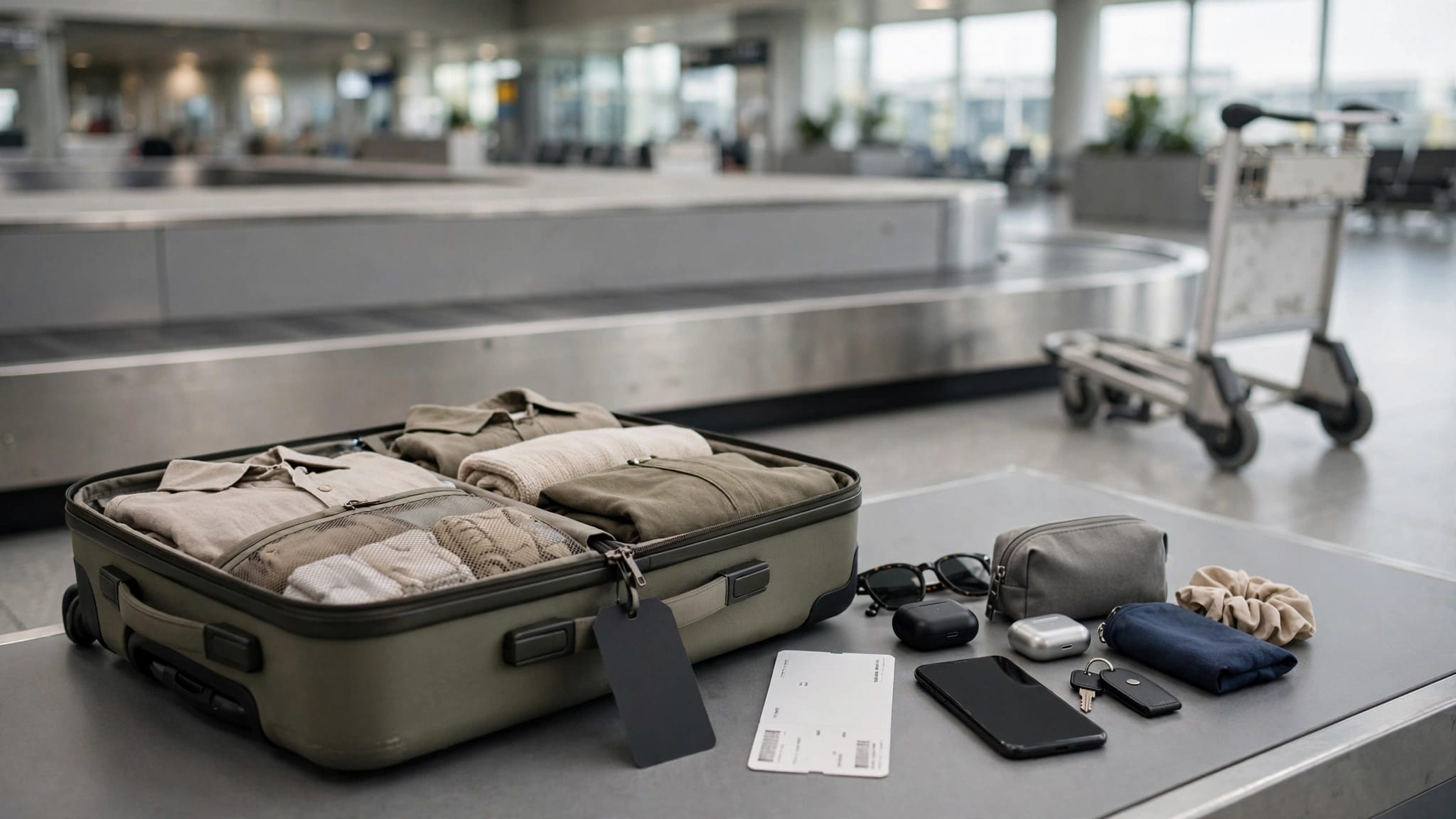
If your suitcase doesn’t appear on the carousel, report it to the airline’s baggage desk before you leave the airport, get a reference number and keep every receipt for the essentials you buy. Those three steps protect your claim while the airline tracks your bag down.
There are few sinking feelings in travel quite like watching the carousel slow to a stop with your suitcase nowhere to be seen, and whether it’s the start of a Canadian road trip or your first evening in Italy, it can feel as though the holiday has fallen at the first hurdle. In my experience of the travel trade, though, most missing bags are delayed rather than lost for good, and the people who come out of it best are the ones who get the paperwork right at the airport and then get on with the practical things that let them keep travelling.
Here’s how I’d handle it, from the moment you realise your bag isn’t coming to the point where you’re putting in your claim.
Key Takeaways
- Report the bag before leaving the airport and get a Property Irregularity Report (PIR) with its file reference.
- Keep your boarding pass, baggage tag and itemised receipts for anything you have to buy.
- The airport report starts the search, but it isn’t your compensation claim, which has to be made separately and in writing.
- On international flights, including UK routes to the USA, Canada, Italy and India, airline liability is capped at 1,519 Special Drawing Rights per passenger, not per suitcase.
- Claim deadlines are short, so put the 7-day and 21-day dates in your diary straight away.
Before You Go: Make a Missing Bag Easier to Deal With
The best protection starts at home, with a cabin bag that holds your medication, travel documents, valuables and at least one change of clothes, so that a missing suitcase is an inconvenience rather than a crisis. I’d also photograph your case and its contents before you close it, which takes a minute and makes both the airport report and any later claim far easier, and put your contact details inside the bag as well as on the outside tag.
If you’re travelling as a family, spreading everyone’s clothes across the different cases means that if one goes astray, nobody is left with nothing to wear. Our multi-stop family holiday advice has more packing ideas for trips with several stops.
A luggage tracker such as an Apple AirTag can be genuinely useful, as being able to show baggage staff exactly where your case is often speeds things along, but it doesn’t replace the airline’s own tracing system, so you’ll still need to report the bag in the normal way. And it’s worth leaving plenty of time at check-in, particularly before a connecting flight, as tight connections are where bags most often get left behind.
At the Airport: Reporting a Missing Bag
Check around before you join the queue
Before assuming the worst, have a look at the neighbouring carousels and the oversize baggage area, as cases do sometimes come off a different belt, and on a busy evening unloading a full aircraft can take the best part of an hour. If you’re not sure, ask at the airline’s baggage office whether unloading has finished, and once it’s clear your bag hasn’t arrived, report it straight away rather than waiting around in hope.
If you had a connecting flight, take your full itinerary to the desk, because the bag may simply still be sitting at your transfer airport even though your own final flight landed on time.
Get the report and the reference number
Ask the airline, or the ground-handling agent working on its behalf, to create a Property Irregularity Report, which you’ll often hear called a PIR. Describe the suitcase’s colour, size, brand and anything distinctive about it, which is where those photos from home come in handy.
Keep the file reference number, photograph the report and make a note of how to track the bag online. If the desk is closed, as it sometimes is late at night, submit the airline’s online missing-baggage report before you leave the airport and keep the confirmation. Hang on to your boarding pass, booking reference and, above all, the numbered baggage tag receipt, which is what identifies your bag in the airline’s system.
Finally, give the staff your phone number and delivery address, and ask how delivery will work, including whether you’ll need to deal with customs.
A PIR starts the search for your suitcase, but it doesn’t submit a claim for your replacement purchases or lost belongings. That’s a separate step, and it has deadlines.
The First Day: Buying Essentials and Arranging Delivery
Spend sensibly and keep itemised receipts
While the airline is searching, you’re entitled to claim for reasonable replacement items such as toiletries, underwear and basic clothing, and the key word there is reasonable, so buy what you genuinely need for the next day or two rather than treating it as an excuse to replace your holiday wardrobe.
I’d keep every itemised receipt, take a photo of it in case it fades or goes missing, and jot down why you needed each purchase. A bank statement proves you paid, but it rarely shows what you actually bought, which is what the airline will want to see.
What counts as reasonable depends on the circumstances. On the way home you’ll usually need very little, because your belongings are waiting for you, but at the start of a trip, warm layers for an autumn road trip in the Canadian Rockies or light clothing for the heat of India can be a perfectly reasonable necessity.
Keep the airline updated as you move
Give the baggage team your next addresses and the dates you’ll be at each one, because a suitcase delivered to last night’s hotel is little help when you’re already three hours down the road. This matters most on a self-drive trip through the USA or Canada, where you’ll want to give your next overnight stop rather than the place you’ve just checked out of, and the same goes for moving between hotels in Italy or India.
Ask for delivery arrangements in writing, and if the airline insists you collect the bag from the airport, keep that instruction along with receipts for any necessary travel costs. You shouldn’t have to spend your holiday shuttling back and forth to the carousel.
What Airlines Owe on International and US Flights
These are the main limits that apply as of October 2026.
|
Journey |
Maximum airline liability for baggage |
|---|---|
|
International journeys, including UK flights to the USA, Canada, Italy or India |
1,519 SDR per passenger (roughly US$2,050) |
|
Standalone US domestic flights |
US$4,700 per passenger |
|
Canadian domestic flights |
1,519 SDR per passenger, mirroring the international rules |
The way your trip is booked matters, because a domestic connection that’s on the same ticket as your international flight is usually treated as part of the international journey.
International flights and the Montreal Convention
Most international journeys fall under the Montreal Convention, whose limits were raised on 28 December 2024. The 1,519 SDR ceiling covers lost, damaged and delayed baggage together, and it applies per passenger rather than per suitcase.
SDRs, or Special Drawing Rights, are an international accounting unit whose value moves with exchange rates every day, so any conversion is only a rough guide.
It’s important to understand that this is a cap, not a payout. The airline will pay what you can prove you lost or reasonably spent, up to that limit, so your receipts and evidence are what determine the amount, and generic “average compensation” figures you’ll see quoted online aren’t much help in valuing your own claim.
Standalone US domestic flights
If you’re taking a separately booked internal flight in the US, say from Denver to Nashville in the middle of a road trip, the US Department of Transportation sets the minimum liability limit at US$4,700 per passenger, up from the US$3,800 you may still see quoted in older guides. Again, that’s the most the airline has to pay for proven losses, not an automatic sum.
US airlines set their own point at which a delayed bag is declared lost, typically somewhere between five and fourteen days, which is different from the international 21-day rule.
Standalone domestic flights within India or Italy have their own rules too, so it’s worth checking the airline’s conditions of carriage rather than assuming the international provisions apply.
The Deadlines That Matter: 7 Days, 21 Days and 2 Years
For claims under the Montreal Convention, these are the dates I’d put in your diary the moment you get home, or better still while you’re still at the airport:
- Damaged bag: complain in writing within 7 days of receiving it.
- Delayed bag: submit a written complaint for your expenses within 21 days of the bag being returned to you.
- Lost bag: your bag can be treated as lost once the airline admits it, or once 21 days have passed since it should have arrived.
- Court action: any legal claim must be brought within 2 years, and no court can extend that.
Chasing the airline by email doesn’t stop that two-year clock, as the airline’s complaints process and the legal time limit run quite separately. And there’s no reason to wait until day 21 to report anything or gather your receipts, as some airlines declare bags lost much sooner.
For US domestic flights, the 45-day claim window that’s often quoted isn’t a universal rule, so I’d submit your written claim promptly even while the bag is still being traced. For domestic flights within Canada, the deadlines are set out in each airline’s tariff, which the Canadian Transportation Agency explains.
Claiming on Travel Insurance
Tell your insurer while you claim from the airline
Start your airline claim and let your travel insurer know at the same time, rather than waiting for the airline’s decision, because most policies have their own notification deadlines. Have a look at the baggage section of your policy, as many UK policies pay a set amount towards essentials once your bag has been delayed for a certain period, often 12 hours, and an excess may apply depending on your level of cover.
That insurance threshold is simply when your policy kicks in, and it doesn’t mean the airline’s responsibility only starts after twelve hours. If you think your bag or its contents have been stolen rather than mishandled, most insurers will want a police report, usually within 24 hours, but an ordinary airline mix-up isn’t theft.
Don’t claim the same expense twice
Send your insurer the PIR, your receipts, your itinerary and the airline’s settlement or rejection, and claim only the eligible amount the airline hasn’t already covered. I’d keep a simple spreadsheet listing each purchase, its receipt and any money received, which keeps everything straight, and it’s worth remembering that a policy limit is the most you can claim under that section, not a fixed sum paid out because your bag was late.
If you hold a US-issued credit card, it may include its own baggage-delay cover, but that doesn’t apply to UK-issued cards just because you’re travelling in America.
Making Your Claim, and Challenging a Refusal
Use the airline’s own baggage claim form, and include your flight details, PIR number, baggage tag number, receipts and the total you’re claiming.
If the bag is lost for good, add an inventory of what was inside, with approximate purchase dates, original prices and any photos or receipts you have. Airlines generally value the contents at what they were worth at the time of loss, allowing for wear and tear, rather than paying the cost of buying everything new, so it pays to be realistic.
If the airline turns your claim down, ask for the reason and the calculation in writing, then escalate through its complaints process and, for UK airlines, any approved dispute-resolution scheme it belongs to.
Compensation for a delayed or cancelled flight is a separate matter entirely, and our flight disruption claims guide covers that if your journey was also disrupted.
Frequently Asked Questions
Can I claim for essentials before my bag is officially lost?
Yes. Reasonable replacement purchases form part of a delayed-baggage claim while the airline is still searching, as long as you keep itemised receipts and can explain why you needed them. Some insurance policies pay out after a set delay, but there’s no universal airline payout after twelve hours, and the spending still has to be reasonable.
What if my suitcase comes back damaged?
Photograph the damage straight away, including the baggage tag, and report it in writing, as the deadline for Montreal Convention claims is seven days from receiving the bag. Mention anything missing from inside it too, and keep the suitcase until the airline has told you whether it wants to inspect it or see a repair assessment.
Will I get my checked baggage fee back?
On flights covered by US Department of Transportation rules, you’re entitled to a refund of the bag fee if your bag is lost, and significantly delayed bags can qualify too. Ask for this separately from your claim for toiletries, clothing or the contents of the case.
Keep the Paperwork, Then Get On With Your Holiday
A missing suitcase is undeniably frustrating, but the best response is a practical one: report it before you leave the airport, keep that reference number safe, and keep a record of everything you have to buy. If I had to single out one thing, it would be the written claim deadlines, which are easy to forget while the airline is still searching, but with those protected and the baggage team kept up to date with where you’re staying, you can spend far less of your trip chasing luggage and far more of it enjoying the journey.

