
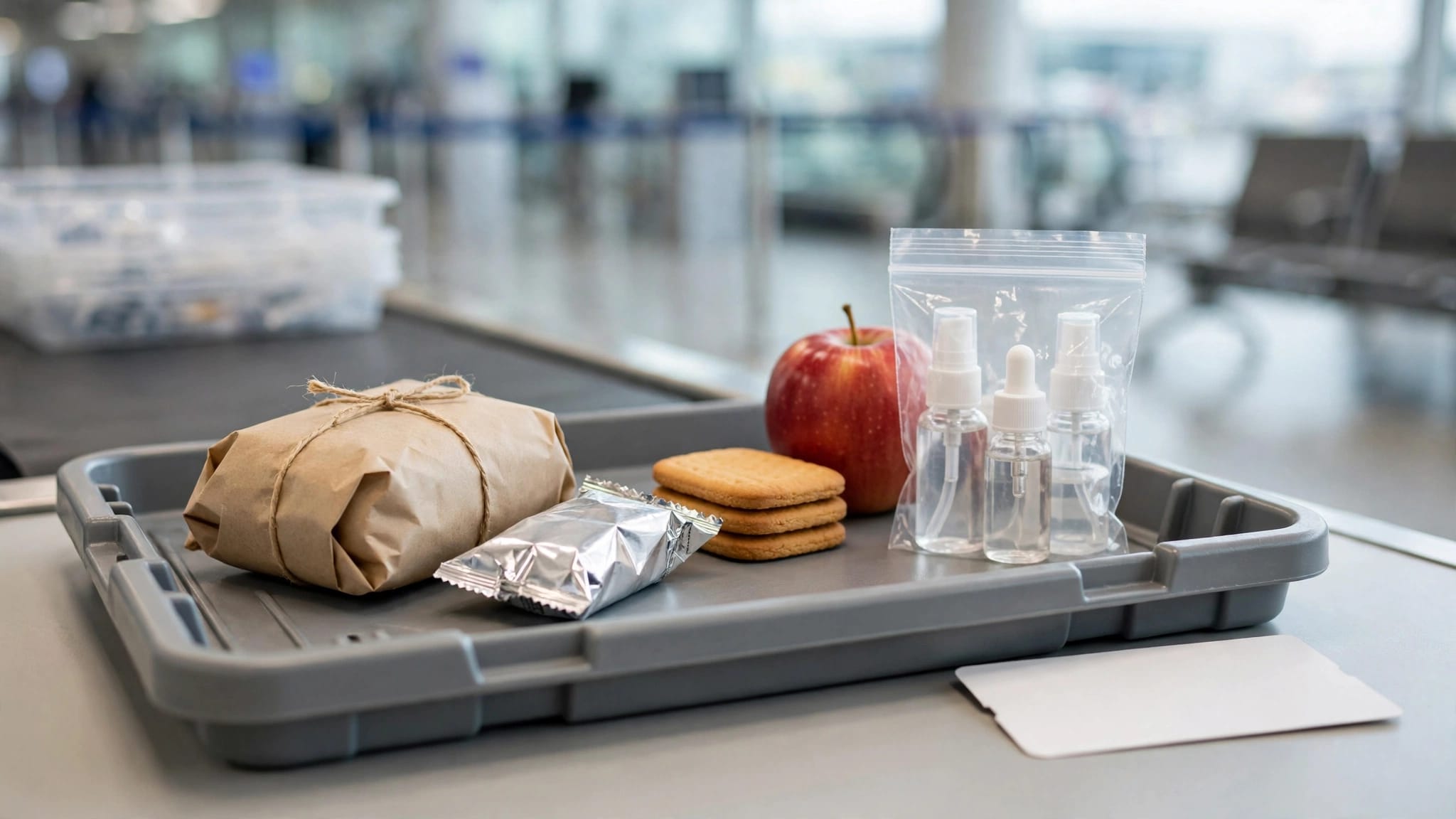
Sandwiches, crisps and fruit will sail through UK airport security, but spreads, drinks and soft foods are treated as liquids, and the limits now depend on which airport you fly from. Here’s what to pack, what to leave at home, and why the bigger risk is often what happens when you land.
One of the most familiar sights at any security tray is someone looking forlornly at a jar of jam or a tub of hummus that they’d assumed was food rather than a liquid, and it’s an easy mistake to make, because the rules are less about what something is and more about how it behaves. The other thing that catches people out is that getting through departures is only half the story, since a sandwich that’s perfectly fine at the security checkpoint in Birmingham might be confiscated, or worse, when you arrive in New York, Toronto, Rome or Delhi.
So I find it helps to think of it as two separate tests: security on the way out, and customs on the way in. My own approach is to keep things simple, pack food I’d be happy to finish before landing, and give a little extra thought to journeys to the USA, Canada, Italy and India, which is where the questions I’m asked most often tend to come from. Let’s start with what can go in your hand luggage.
Key Takeaways
- Solid foods, including sandwiches, crisps, biscuits, cakes and fruit, are generally fine through UK security.
- Anything that spreads, pours, smears or sprays counts as a liquid, so jam, honey, peanut butter, hummus and yoghurt all fall under the liquid rules.
- As of October 2026, nine UK airports allow liquid containers of up to two litres, while the rest, including Manchester, Stansted, Luton and East Midlands, still apply the 100ml limit.
- Baby food, baby milk and essential medicines are exempt from the 100ml rule at every UK airport.
- Customs rules apply to food in both cabin and hold luggage, and they’re where most holiday snacks come unstuck.
What Solid Food Can Go Through UK Airport Security?
Sandwiches, snacks and fruit
The good news is that most of what you’d naturally pack for a journey is absolutely fine. Homemade sandwiches, wraps, crisps, biscuits and cakes can all travel in your hand luggage, and so can whole or sliced fruit, although as we’ll see later, fruit is one of the first things to fall foul of import rules at the other end.
There’s no need to keep everything in its original packaging. A sealed shop label can make it quicker for staff to identify what’s in front of them, but a sandwich made at home doesn’t need a manufacturer’s label, and a clean, secure container that you can open easily if asked does the job perfectly well.
If you’re travelling with children, I’d lean towards crackers, rice cakes, dry cereal and raisins, split into small bags or boxes so you can hand them out gradually rather than watching the whole supply disappear before you’ve even reached the gate.
Homemade meals and uncooked meat
A solid cooked meal, such as rice with vegetables or pasta without a runny sauce, will pass security, but soup, curry sauce and separate pots of dip are another matter, because those fall under the liquid restrictions.
Raw food isn’t banned by security simply because it’s uncooked, though it does need secure, leakproof packaging, and keeping it safely chilled for the length of a journey is a challenge in its own right. The bigger obstacle is customs, because meat that clears a UK departure checkpoint may well be prohibited when you land, so for international trips it’s not something I’d ever put in a cabin bag.
Which Foods Count as Liquids at Security?
Peanut butter, honey and jam
Yes, these all count as liquids, along with marmalade, Nutella, hummus, golden syrup and treacle. The simplest rule of thumb, and one that’s widely used by travel sites, is that anything which spreads, smears, pours or sprays belongs in the liquid category, which also sweeps up yoghurt, soup, sauces and spreadable cheese.
What surprises a lot of people is that a normal sandwich with a thin layer of spread inside is treated as solid food, whereas a separate tub of that same spread is a liquid, which is a good reason to make up your sandwiches at home rather than packing a little picnic of dips and jars.
How the 100ml rule works
At airports still applying the standard restriction, every container must have a capacity of 100ml or less, and it’s the size of the container that counts rather than how much is left in it, so a 200ml bottle with only 50ml inside will still be taken off you. Where the airport asks for a bag, everything goes into a single clear, resealable plastic bag of roughly 20cm x 20cm, holding no more than a litre, and it needs to close comfortably.
Food liquids share that allowance with your toothpaste, cosmetics and other toiletries, so if your bag is already full of travel-sized bottles, I’d simply stick to solid snacks. A clear toiletries pouch is handy for keeping everything together, but it’s worth knowing that a “TSA approved” label on a product doesn’t override the UK rules.
Do All UK Airports Have the Same Liquid Limits?
No, and this is where most of the confusion comes from. Airports have been installing new CT scanners and getting approval for higher limits one at a time, so as of October 2026 the picture looks like this.
|
Departure airport |
Liquid container limit |
Worth knowing |
|---|---|---|
|
Heathrow (all terminals), Gatwick, Birmingham, Edinburgh, Bristol, London Southend, Bournemouth, Belfast International, Belfast City |
Up to 2 litres per container |
Liquids stay in your cabin bag; metal and insulated bottles must be empty |
|
Manchester, Stansted, Luton, East Midlands, Glasgow, Liverpool, London City, Aberdeen, Newcastle, Teesside and most regional airports |
100ml per container |
Some no longer need a clear bag, as liquids can stay in your bag for screening |
The key thing to understand is the difference between container size and screening procedure. Being allowed to leave liquids inside your bag at a 100ml airport doesn’t mean you can carry larger containers, and a two-litre container limit isn’t a two-litre total allowance either. Your airline’s own baggage limits still apply, and if you’re changing planes, the transfer airport may well apply the 100ml rule again, which is easy to forget on the way home, as many Spanish and Portuguese airports still do.
Because airports keep moving from one column to the other, I’d always check your departure airport’s own security page a day or two before you fly.
For water, my advice is to carry an empty reusable bottle and fill it up once you’re airside, since most UK airports now have free water fountains after security. Empty any metal or insulated bottle before screening, even at airports that accept larger containers, and note that Newcastle doesn’t accept metal or double-walled bottles at all, even empty.
What About Baby Food, Frozen Food and Packaging?
Baby milk and baby food
Baby food, baby milk and sterilised water needed for the journey are exempt from the 100ml rule at every UK airport, in containers of up to two litres, and there’s no fixed total, although everything is still screened and staff may open containers to test them. That exemption only applies to security, mind, and it doesn’t change the customs rules at your destination.
Formula, sterilised water and baby food normally require the baby to be travelling with you, but expressed breast milk can travel without your baby in individual containers of up to two litres, ideally in clear containers or proper breast-milk storage bags. Frozen breast milk isn’t allowed in hand luggage, though it can go in the hold, and cooling gel packs for breast milk are permitted. Yoghurt pouches for older children, on the other hand, follow the airport’s normal liquid rules.
Frozen meals, ice packs and foil
Freezing a soup or sauce doesn’t get it round the liquid rules, and frozen food and ordinary ice packs tend to cause problems at screening, particularly once they start to thaw, so the breast-milk cooling allowance really is a separate exception.
Foil-wrapped food isn’t banned, but foil and densely packed meals can obscure the scanner image and lead to your bag being pulled for a closer look, which is why I prefer a simple food box that opens easily. Anything that can’t be cleared won’t get through, and surrendered items aren’t kept for you to collect on the way home.
For long-haul flights in particular, I’d always choose familiar, non-sticky nibbles, which are far easier to manage in a cramped seat than anything elaborate.
What Food Can You Bring Back Into Great Britain?
Great Britain means England, Scotland and Wales, as Northern Ireland has its own arrangements, and the border rules apply whether the food is in your hand luggage or your checked suitcase.
Cheese and ham from Spain, Italy or France
Sadly not. Since April 2025, personal imports of meat and dairy from any EU country have been banned to protect British livestock from foot-and-mouth disease, and the ban is still in place. That covers beef, pork, lamb, mutton, goat and venison, and anything made from them, along with milk, butter, cheese and yoghurt, so the Manchego from a Spanish market or the Parmesan from an Italian deli has to stay behind, even in sealed shop packaging or bought in duty free. It applies to arrivals from the Republic of Ireland too, and it even catches a ham or cheese sandwich bought at the airport or on the plane if it’s still in your bag when you reach UK customs, although anything you eat on board is fine.
Poultry, fish, eggs and honey are treated differently, and there are limited exceptions for infant milk and medical foods. Prohibited items will be surrendered or seized and destroyed, and in England you could face a fine of up to £5,000. Vacuum sealing makes no difference.
From the USA, Canada or India
Meat, meat products, milk and most milk-based products are prohibited from these countries too. You can bring back up to 2kg of honey per person and up to 20kg of qualifying fish and fish products, although fresh fish must be gutted, and egg products have their own separate, origin-based rules.
Plain bread, biscuits, sweets, chocolate, cakes without fresh cream and pasta without meat are generally unrestricted from anywhere, which is good news for anyone bringing home a box of maple cookies or a bag of American candy, although a prohibited filling changes the answer. Fruit, vegetables, nuts and seeds come under separate plant-health rules, so a souvenir containing them needs more thought than an ordinary packet of biscuits.
The GOV.UK guide to bringing food into Great Britain lets you check the rules by country and product, and it’s well worth a look before you start filling your suitcase.
Frequently Asked Questions About Food on Flights
What changes when flying to the USA or Canada?
UK security rules govern your departure, but American and Canadian import rules govern your arrival, and both countries require you to declare any food you’re carrying. Fresh fruit and animal-derived foods are commonly restricted, even though they were perfectly acceptable on the plane, so an apple from your lunchbox is best eaten or binned before you land.
For flights to the US, there’s also the TSA’s powder rule to bear in mind, under which powders over 350ml (12 US fluid ounces) in your cabin bag may need extra screening. That can affect coffee, sugar, spices, protein powder and powdered cosmetics, but it’s a volume guide rather than a ban, and anything that can’t be cleared won’t be allowed on board, so larger quantities are better off in the hold.
What about taking snacks to Italy or India?
For Italy, UK security might happily wave through a ham or cheese sandwich, but EU rules prohibit bringing meat and dairy products into the EU from Great Britain, so it needs to be eaten before you arrive, with only limited exceptions for infant and medical foods.
India also applies agricultural controls to plant material and animal products, so I’d stick to clearly labelled, commercially packaged dry snacks for the flight rather than fresh produce, homemade milk-based dishes or anything containing raw ingredients. For either destination, food eaten on the flight causes far fewer problems than leftovers carried across the border, so I’d bin anything restricted before you reach passport control.
Do domestic flights follow the same rules?
Yes, the departure airport’s security rules apply whether you’re flying to Glasgow or Cancún, so a domestic hop doesn’t let you off an oversized yoghurt pot or bottle of water at a 100ml airport. A flight within Great Britain doesn’t cross an import border, though journeys involving Northern Ireland have their own food and plant-health arrangements.
It’s also worth remembering that buying food after security doesn’t exempt it from customs, as an airport purchase can still be prohibited at your destination.
Pack for the Flight, Not Just the Checkpoint
Light bites and a well-made sandwich are nearly always the easiest option, while spreads, drinks and soft foods need a little more thought now that liquid allowances vary from one airport to the next. If I had to boil it all down to one piece of advice, it would be to keep the two tests separate in your mind, what will get through security and what will be allowed into the country you’re landing in, and to plan to finish your food before you get there. Do that, and the only conversation you’ll have about the contents of your lunchbox is with whoever you’re sharing it with.

